
During the honeymoon period that followed accepting Christ as my saviour, I celebrated, and others celebrated me. I felt loved and welcomed by my new church family and my pastor. I think they saw me as all shiny and new, and I was that in many ways.
I know I’m changing the metaphor from birth to a different and much later life change, but in some ways, entering a church community is more like marriage than rebirth. After that first period of discovery of all things good about one another, it was inevitable that things would become a little more “real”. After all, I wasn’t actually a baby. I was a full-grown woman who had spent considerably more of her years outside a church than in one.
One of the first hurdles was the language. Everyone around me seemed to be comfortable using words like “righteousness”, “iniquity”, grace”, “sin” and “redemption”, words that had never once come up in conversation before I became a Christian. Now, they were all around me, and it seemed impolite to keep interrupting the flow, so I mostly kept silent and tried to learn what they meant from context.
Well, that didn’t really help.
I think perhaps it’s because people who have been Christians a long time are used to those words, or perhaps they already have a fixed understanding of what they mean. They certainly seemed comfortable with them. At the beginning, I decided it was just another language I would learn eventually, much as I had learned other languages in my work overseas: namely, by osmosis.
It wasn’t just individual words either. Pieces of scripture were often quoted, and some of them, like “all our righteousness is as filthy rags” from Isaiah 64:6, presented a pretty horrible image in my mind. Every time someone said it, I balked and tried mostly to forget it. I didn’t feel like I would ever understand it, and I wasn’t sure I wanted to.
This was my early experience with parts of the Bible as well. I remember my heart withdrawing in shock when I read about a whole family being swallowed up my the earth because the head of the family, Achan, had disobeyed God’s orders when he took loot from Jericho (Joshua 6 and 7). My head was reeling. The whole family? When I looked around the church, everyone else seemed okay with this. I was shocked.
i don’t know what I would have done without my husband at those moments. He listened to my reaction to this and other parts of the Bible (like the story of Lot offering his daughters to rapists), and his response was always the same: “Don’t try to understand it, sweetheart. When you hit a wall, leave it with God.”
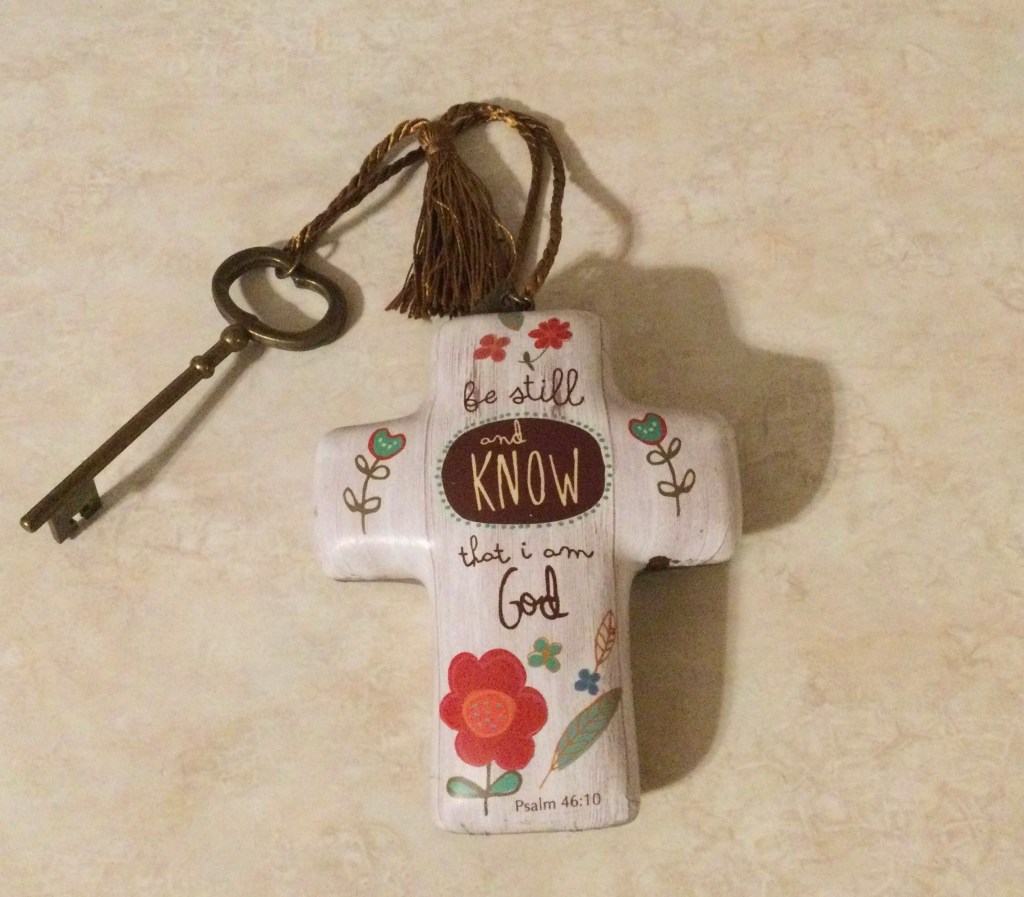
There were lots of walls in those early days of reading the Bible for the first time, and I tried my best to do what my husband recommended. I was surprised at how often it worked. Over time, God seemed to soften those ugly pictures and the dismay in my heart. I’m not sure how He did it, but I was eventually able to take the language of the Bible and its powerful stories and fit it into a growing relationship with a God who is intimately involved with His creation. My favorite verse during that time was on a small ceramic cross given to me in celebration of my baptism: “Be still, and know that I am God.” (Psalm 46:10) I looked at that cross and said those words often. They were my pledge of faith at that time, and I still consider them an essential tool for the kind of character transformation that God desires for his children.
Praise God, the master of stillness along with everything else.

 Late At The Well
Leave a comment